Get The Peace You Deserve
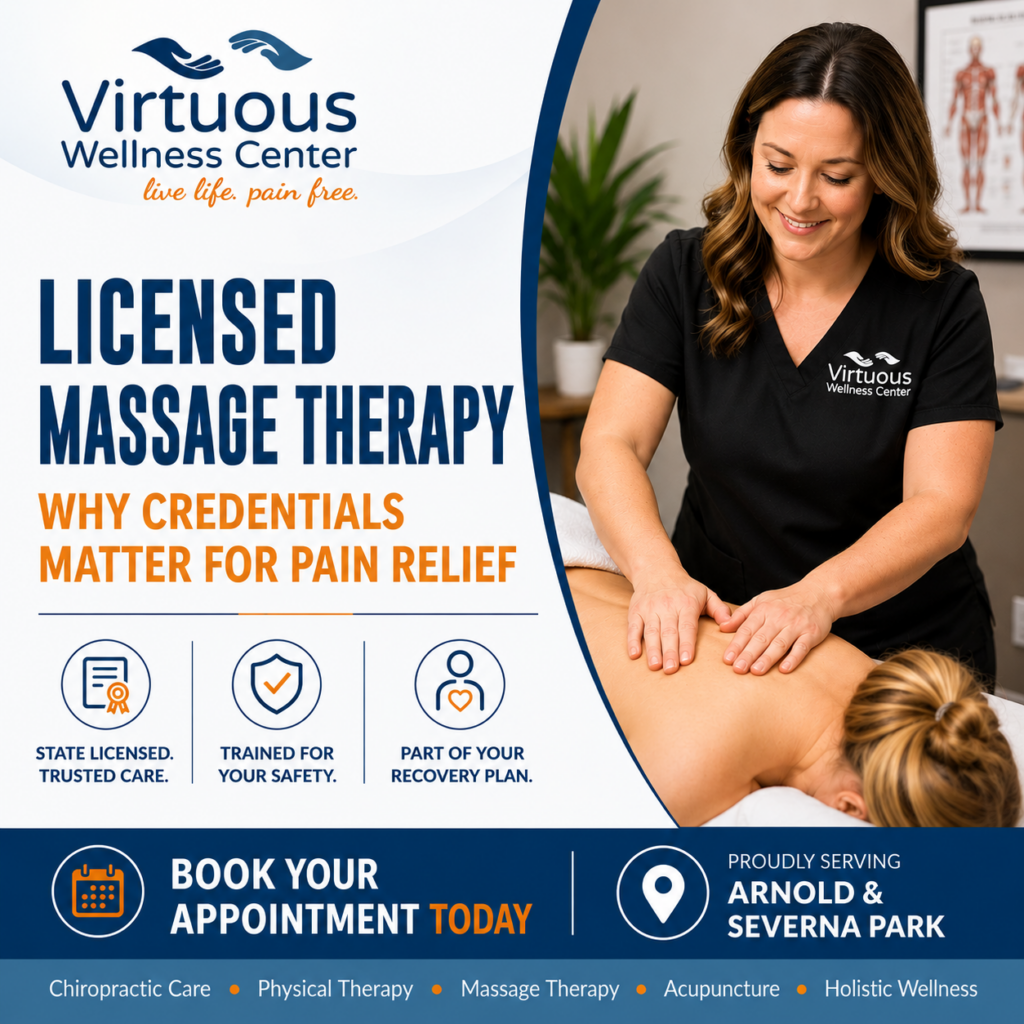
Licensed Massage Therapy – Why Credentials Matter For Pain Relief
Want to listen to our Blog? Click on the audio above!
Brittany - Licensed Massage Therapist at Virtuous Wellness Center
Massage sounds simple — hands, muscle, tension released. But in Maryland, the person whose hands are doing that work matters more than most patients realize. “Massage therapist” isn’t just a job title here. It’s a credential the state actively regulates, and knowing what stands behind it can change who you trust with your pain.
It’s easy to assume massage is massage — that a soothing hour is a soothing hour no matter who’s giving it. But when massage is part of an actual recovery plan, and not just a once-a-year spa treat, the training and oversight behind the person doing it stop being a nice-to-know and start being something you should ask about directly.
What Licensure Means in Maryland
Every massage professional practicing in this state answers to the Maryland State Board of Massage Therapy Examiners. The Board doesn’t just hand out titles — it sets the bar and checks that people clear it, then keeps checking.
There are two recognized tracks, and the difference between them is bigger than most people expect:
- Registered Massage Practitioner (RMP) — completes at least 600 hours of accredited training.
- Licensed Massage Therapist (LMT) — completes at least 750 hours of accredited training.
That extra 150 hours isn’t a technicality. It’s what allows an LMT to practice in a medical or healthcare setting — something an RMP is not permitted to do under Maryland law. Both tracks require passing a national exam (typically the Massage & Bodywork Licensing Examination (MBLEx), administered by the Federation of State Massage Therapy Boards) plus Maryland’s own jurisprudence exam covering state-specific law and ethics, along with a criminal background check before a license is ever issued.
In other words: when you’re being treated inside a healthcare practice, the credential in the room isn’t optional paperwork. It’s the difference between someone who’s cleared to be part of a medical treatment plan and someone who isn’t.
Learn More About Our Services!
Why This Matters When Massage Is Part of a Bigger Plan
At Virtuous Wellness Center, massage doesn’t happen in isolation. It sits alongside physical therapy, chiropractic care, acupuncture and dry needling, and occupational therapy — one team, one plan, built around you instead of shuttling you between separate offices for related care.
That kind of coordinated care only works if every hand in the room is qualified to be part of a real treatment plan, not just a relaxing hour. A massage therapist working inside a healthcare setting needs to understand how their work interacts with what your chiropractor, physical therapist, or acupuncturist is doing that same week — what to communicate back to the team, what to flag, what to adjust. That’s a different skill set than a standalone relaxation service, and it’s exactly the skill set Maryland’s LMT track is built to require.
What a Visit Actually Looks Like
You shouldn’t have to guess what you’re walking into. A massage session that’s part of a coordinated plan usually starts with a conversation — what’s bothering you, what other treatment you’re receiving, what you’re hoping changes. From there, the approach gets tailored to you specifically, not applied as a one-size routine. That’s the personalized, whole-person model VWC is built around: your care team talking to each other, not treating your pain in five disconnected pieces.
Take Your Life Back – One Credentialed Hand at a Time
Credentials aren’t the exciting part of a massage. Relief is. But relief built on a real standard — training, testing, accountability, ongoing education — is relief you can actually trust, especially when it’s one piece of a bigger plan to get you back to your life.
Pain doesn’t wait. Neither should you. If tension, chronic tightness, or recovery from another treatment has you stuck, let’s talk about where credentialed massage therapy fits into your plan.
Take The Next Step
Living with pain can make even simple daily activities frustrating, but you don’t have to figure it out alone.
If you’re experiencing pain, our team can help identify what’s causing your symptoms and develop a treatment plan tailored to your needs. Whether your recovery involves physical therapy, chiropractic care, acupuncture, massage therapy, occupational therapy, or a combination of services, our focus is helping you return to the activities that matter most.
Contact Virtuous Wellness Center to schedule an evaluation and learn which treatment options are right for you.
This article is intended for educational purposes only and does not replace a medical evaluation. If you experience sudden leg weakness, loss of bowel or bladder control, numbness around the groin, or pain following a serious injury, seek immediate medical care.
Ready to Start Feeling Better?
Other Blogs & Articles:

Frequently Asked Questions
What’s the difference between a Licensed Massage Therapist (LMT) and a Registered Massage Practitioner (RMP) in Maryland?
A: An LMT completes at least 750 hours of accredited training and can practice in medical/healthcare settings; an RMP completes at least 600 hours and cannot. Both must pass a national exam and Maryland’s jurisprudence exam.
Do I need a referral to see a massage therapist at Virtuous Wellness Center?
Depending on your insurance provider coverage, you may need a referral. However we also offer self-pay options including discounted packages.
Is massage therapy covered by insurance?
Coverage varies by plan. Contact our team to confirm your specific benefits before your visit.
How does massage therapy fit into a broader treatment plan?
At VWC it’s coordinated with your other providers — Physical Therapy, Chiropractic Care, Acupuncture, Occupational Therapy — as one plan rather than a standalone service.