Get The Peace You Deserve
Understanding Sciatica: What it is, What Causes It, and the Most Effective Ways to Find Relief
Want to listen to our Blog? Click on the audio above!
If you’ve ever had a shooting pain that starts in your lower back and travels through your hip, buttock, and leg — sometimes all the way to your foot — you already know sciatica isn’t subtle. It can turn sitting through a movie, picking up a grandchild, or just standing at the sink into something you brace for.
The good news? Most people without sciatica improve without surgery. With the right diagnosis and a personalized combination of evidence-based, non-surgical treatments, many people experience significant relief and return to the activities they enjoy.
Understanding what’s causing your pain is the first step towards treating it effectively.
What Sciatica Actually Is
Think of your spine as a highway system, and your nerves as the roads branching off to deliver signals throughout your body. The sciatic nerve is the largest of those roads. It begins as several nerve roots in your lower back, joins together near your pelvis, and travels down the back of each leg to your foot.
Sciatica happens when one of those nerve roots becomes irritated or compressed before it joins the sciatic nerve—like a fallen tree blocking part of an on-ramp. The nerve still sends signals, but those signals become disrupted, creating pain, numbness, tingling, or weakness along the entire path of the nerve. That’s why you may feel pain in your calf or foot even though the problem often starts in your lower back.
Learn More About Our Services!
What’s Usually Causing It
Several common conditions can irritate the sciatic nerve.
A herniated disc is the most common cause. The discs between your vertebrae act like cushions with a tougher outer layer and a softer center. If the inner material pushes outward, it can press against a nearby nerve root.
Spinal stenosis, or narrowing of the spaces around the nerves, becomes more common with age. Bone spurs and arthritis can also reduce the room available for the nerves to travel comfortably.
Piriformis syndrome can produce symptoms similar to sciatica. The piriformis is a small muscle deep in the buttock that sits close to the sciatic nerve. If it becomes tight or irritated, it may place pressure on the nerve.
Repetitive lifting, prolonged sitting, or poor movement mechanics can also contribute by placing ongoing stress on the lower back and surrounding muscles.
Many people can’t identify one specific injury. Instead, symptoms gradually appear over several days or even wake them up one morning. That’s common and doesn’t necessarily mean you’ve done anything wrong.
What It Feels Like
Sciatica usually affects only one leg. Many people describe it as:
- Sharp, shooting, or burning pain
- Tingling or “pins and needles”
- Numbness Weakness in the leg or foot
- Pain that’s worse with prolonged sitting
- Relief with gentle walking or changing positions
Symptoms vary from person to person depending on which nerve root is irritated and how severely it’s compressed.
When Should You Seek Immediate Medical Care?
While most cases improve with conservative treatment, some symptoms require urgent medical attention.
Seek emergency medical evaluation if you experience:
- Sudden or significant weakness in your leg
- Loss of bowel or bladder control
- Numbness around the groin or saddle area
Sciatica following a serious fall, accident, or other major trauma These symptoms may indicate a more serious condition requiring immediate treatment and shouldn’t be managed through a routine wellness appointment.
How Whole-Person Care Can Help
The encouraging news is that most people recover without surgery. Current clinical guidelines recommend starting with conservative, non-surgical treatments that help reduce pain, restore movement, and improve function before considering more invasive options.
At Virtuous Wellness Center, we believe the best outcomes come from treating the individual—not just the diagnosis. Rather than relying on a single therapy, we build a personalized treatment plan based on what’s driving your symptoms and your goals for recovery.
PHYSICAL THERAPY
For most people, physical therapy is the foundation of successful sciatica treatment and has the strongest scientific evidence supporting its use. Research consistently shows that targeted stretching, strengthening, movement retraining, and core stabilization help reduce pain, improve function, and lower the risk of future flare-ups.
Our physical therapists identify the movements and muscle imbalances contributing to your symptoms, then create an individualized exercise program that progresses as you heal. Instead of simply treating today’s pain, physical therapy helps build the strength and movement patterns that support long-term recovery.
CHIROPRACTIC CARE
Chiropractic care is one of the best-studied hands-on treatments for low back pain and sciatica-related conditions. Rather than focusing on “putting bones back into place,” modern chiropractic care aims to improve spinal mobility, reduce joint restrictions, and restore normal movement.
For appropriately selected patients, spinal manipulation can help reduce pain and improve function, particularly when it’s combined with an active rehabilitation program like physical therapy.
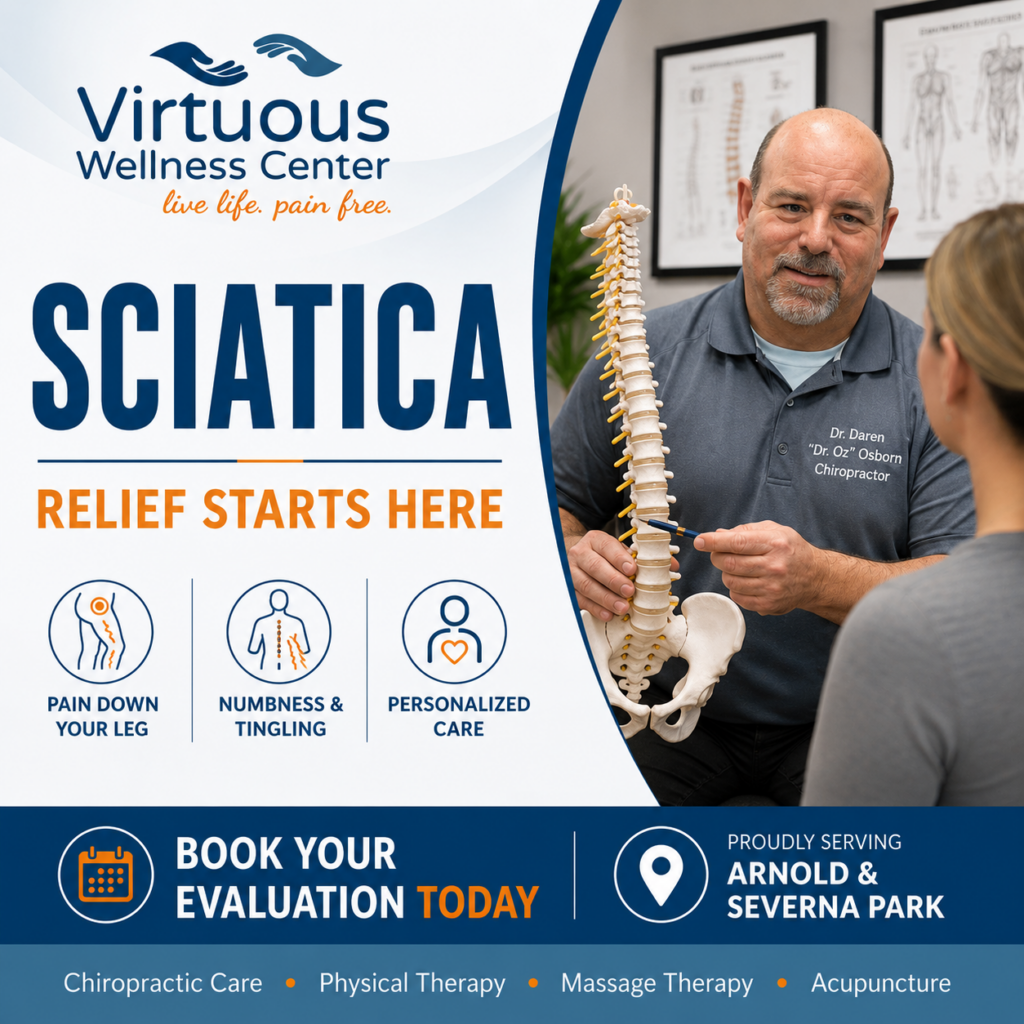
At Virtuous Wellness Center, our primary chiropractor, Dr. Daren Osborn, carefully evaluates your condition before recommending treatment, ensuring spinal manipulation is appropriate for your specific symptoms and recovery goals.
ACUPUNTURE
Acupuncture has growing evidence supporting its use as part of a comprehensive treatment plan for sciatica.
Thin, sterile needles stimulate specific points in the body that may help reduce pain, calm irritated nerves, and improve circulation. While acupuncture isn’t a cure for the underlying cause of sciatica, many patients experience meaningful pain relief and improved function when it’s combined with exercise-based rehabilitation.
MASSAGE THERAPY
Sciatica often causes surrounding muscles to tighten in an effort to protect the painful area. Unfortunately, that muscle guarding can make symptoms even worse.
Massage therapy helps reduce muscle tension, improve circulation, and restore comfort to the muscles surrounding the irritated nerve. While massage doesn’t remove pressure from the nerve itself, it can make moving, exercising, and participating in rehabilitation much more comfortable.
OCCUPATIONAL THERAPY
Recovery isn’t just about what happens during treatment appointments—it’s about how you move throughout your day.
Occupational therapy focuses on practical strategies for sitting, lifting, sleeping, driving, and working with less strain on your back. Small adjustments to posture, workstation setup, and daily movement habits can reduce stress on healing tissues and help prevent future flare-ups.
DRY NEEDLING
Dry needling is another treatment that may benefit certain patients, particularly when muscle tightness is contributing to pain.
Unlike acupuncture, dry needling targets specific trigger points within muscles to help reduce tension and improve movement. Research is still evolving, but it may provide short-term pain relief when used alongside exercise and other active treatments.
Take The Next Step
Living with sciatica can make even simple daily activities frustrating, but you don’t have to figure it out alone.
If you’re experiencing pain that travels down your leg, our team can identify what’s causing your symptoms and develop a treatment plan tailored to your needs. Whether your recovery involves physical therapy, chiropractic care, acupuncture, massage therapy, occupational therapy, or a combination of services, our focus is helping you return to the activities that matter most.
Contact Virtuous Wellness Center to schedule an evaluation and learn which treatment options are right for you.
This article is intended for educational purposes only and does not replace a medical evaluation. If you experience sudden leg weakness, loss of bowel or bladder control, numbness around the groin, or pain following a serious injury, seek immediate medical care.
Take the First Step Toward Recovery
Physical therapy can help reduce pain, improve movement, restore strength, and rebuild the confidence to enjoy everyday life again. Whether you’re recovering from surgery, managing chronic pain, or rehabilitating a sports injury, the team at Virtuous Wellness Center is here to help you move better—and live better.
Ready to Start Feeling Better?
Other Blogs & Articles:

Frequently Asked Questions
What does sciatica pain actually feel like?
Most people describe it as a sharp, burning, or shooting pain that starts in the lower back or buttock and travels down one leg. Some also notice tingling, numbness, or a heavy, weak feeling in the leg or foot.
What causes sciatica?
Sciatica usually happens when a nerve root in the lower back gets compressed or irritated — most often from a herniated disc, bone spurs, spinal narrowing, or a tight piriformis muscle. Prolonged sitting and repetitive strain can also contribute.
How long does sciatica usually last?
Many cases ease within a few weeks with supportive care and activity modification. Recovery time varies by cause and severity, so a personalized evaluation is the best way to know what to expect for your situation.
Is walking okay if I have sciatica?
For many people, gentle movement like walking is more helpful than staying still, and it’s often recommended alongside other care. Everyone’s case is different, so it’s worth checking with a provider before starting or changing an activity routine.
Can chiropractic care help with sciatica?
Spinal manipulation is recognized by national health researchers as effective for reducing pain and improving function in low-back-related conditions. A chiropractic evaluation can determine whether it’s a good fit for your specific symptoms.
Do I need surgery for sciatica?
Most sciatica cases do not require surgery and improve with non-invasive care such as physical therapy, chiropractic care, and lifestyle adjustments. Surgery is generally reserved for severe or worsening cases — a healthcare provider can help determine what’s appropriate.
When should I see a doctor instead of scheduling a wellness visit?
Seek immediate medical care if you experience sudden, severe leg weakness, loss of bladder or bowel control, or pain following a serious fall or accident. These can signal a more urgent issue that needs prompt evaluation.
What’s the difference between sciatica and regular back pain?
General back pain typically stays localized to the back. Sciatica specifically involves the sciatic nerve pathway, so the pain radiates — usually down one leg — and can come with numbness or tingling that ordinary back pain doesn’t cause.